How to follow money-flow patterns
First import a bank statement. Then open Records in the case bar and pick Financial on the left. It has five tabs.
| Section | What it gives you |
|---|---|
| Findings | Cards with a sentence, a likelihood word, what it cannot tell you, and the payments behind it. |
| Payments | A table you can filter and export. |
| Money flow | A chart of accounts with a line for each flow. |
| Theme lines | One line per account. Ticks up are money in. Ticks down are money out. |
| Import | Add more statements. |
Date range and filters (a date range, a smallest amount and a currency) applies to all five. Analyse again reruns the findings.
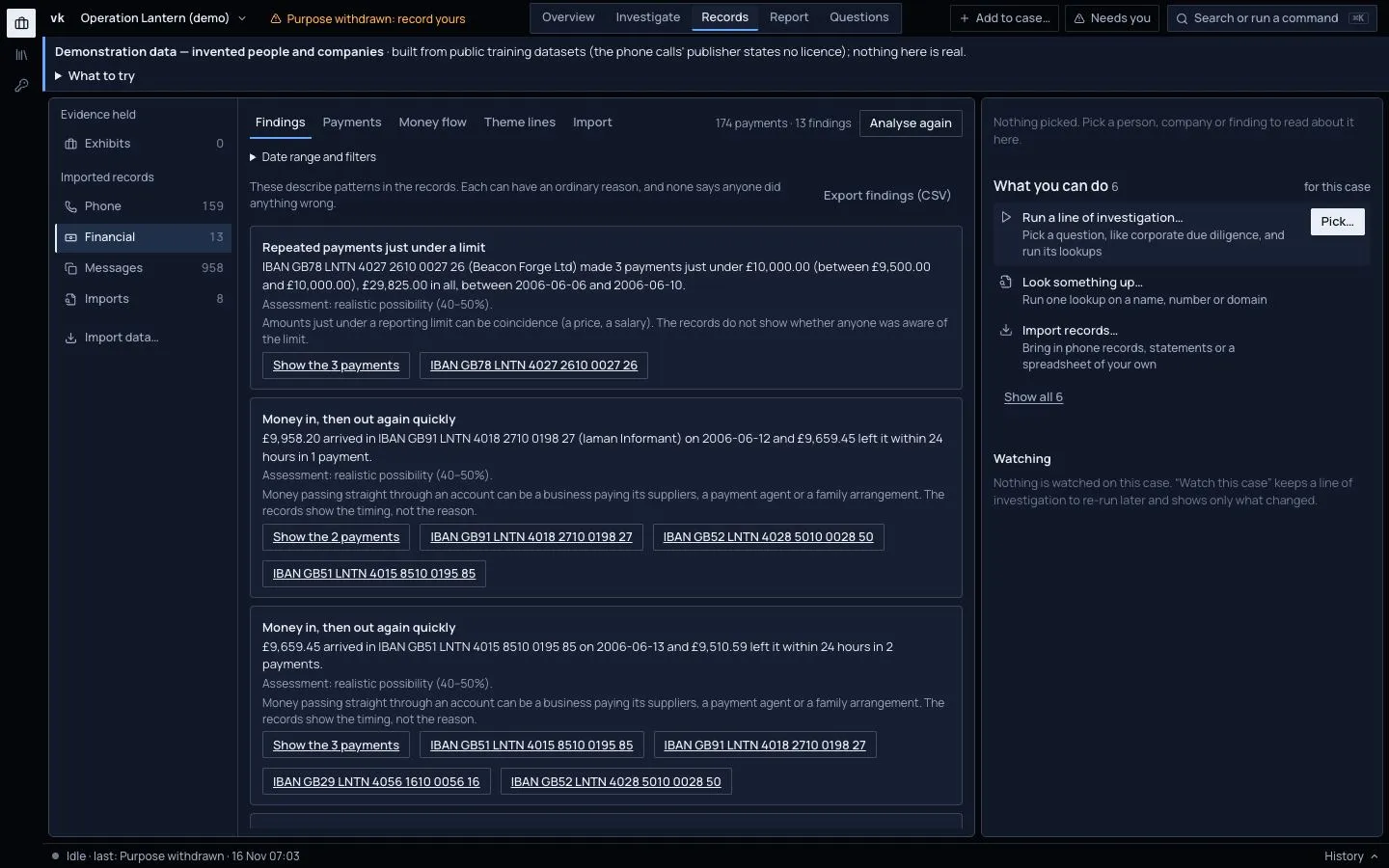
What the findings look for
| Finding | It appears when |
|---|---|
| Round amounts | Several payments are exact hundreds, and make up at least half of that payer's payments. |
| Just below a limit | Several payments from one payer sit just below 10,000. |
| Money in, then out | A payment arrives and most of it leaves the same account within two days. |
| Circular flow | Money goes from A to B to C and back to A, in similar amounts, within a week. |
| Large payment to a new counterparty | A big payment goes to someone first seen only days before. |
| Cash withdrawals | Several cash withdrawals in a week. |
| High-risk country | An account whose bank details place it in a country on the high-risk list. |
| Sanctions-screen name | A counterparty whose holder matches a sanctions list. |
Each finding says what it cannot tell you. A round amount is common in rent. Money passing through an account may be a business. A sanctions name is a name match. Check the holder before you believe it.
The country comes from the account number. It says where the account is held, not where the person is. The high-risk list is a policy choice that changes.
Read the chart
Open the Money flow tab. Each dot is an account. Each line is a flow, thick by how much moved, labelled with the total and the number of payments, with an arrow to whoever was paid.
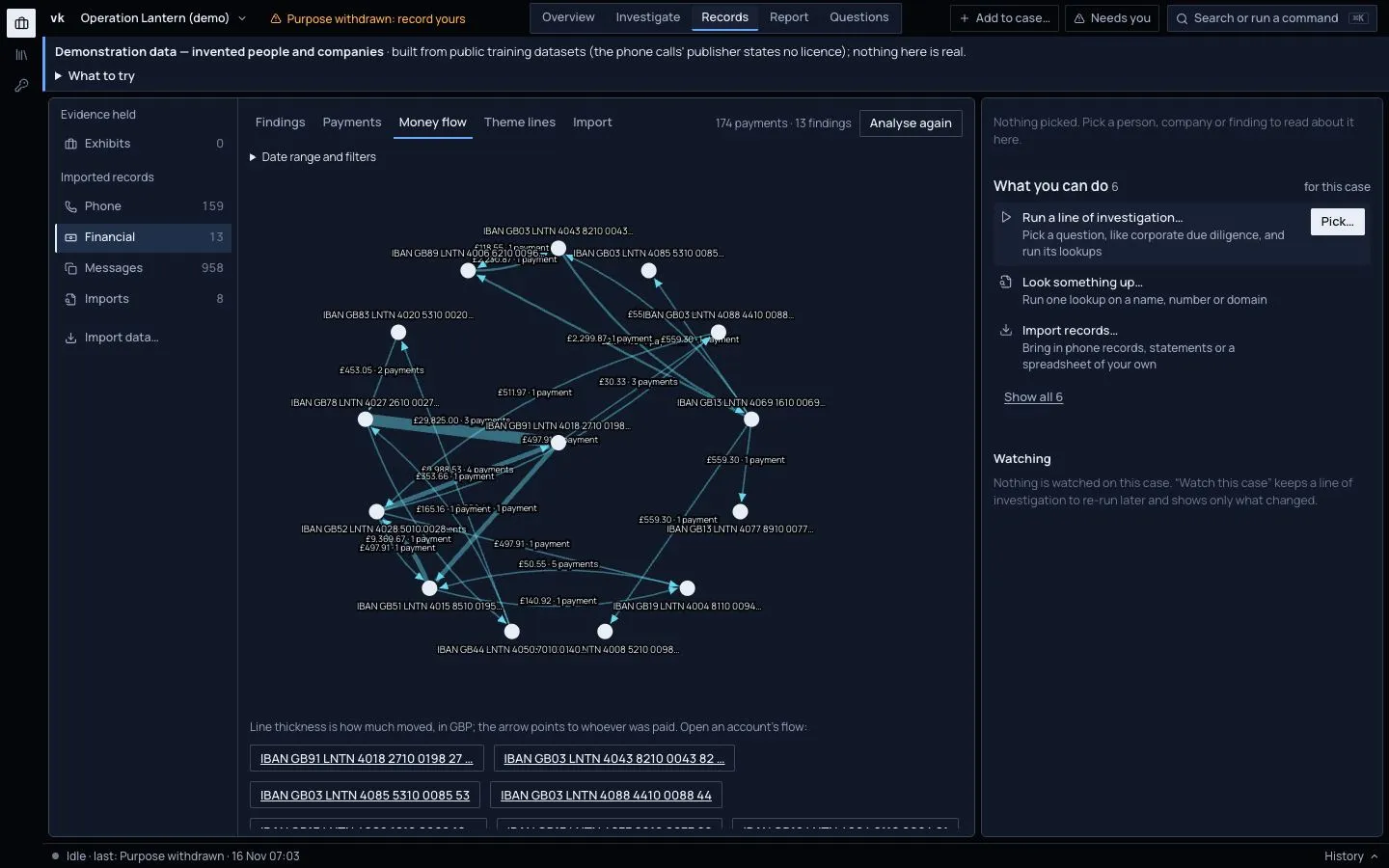
Under the chart, pick one account to open its own flow: payers on the left, payees on the right.
The case's link chart, Investigate › Graph, draws payments the same way: one line per pair of accounts, read "3 payments · £29,825", thicker for more money. Click a line to list each payment, its amount and its source, in the dossier. See Calls and payments as links.
See payments over time, by person
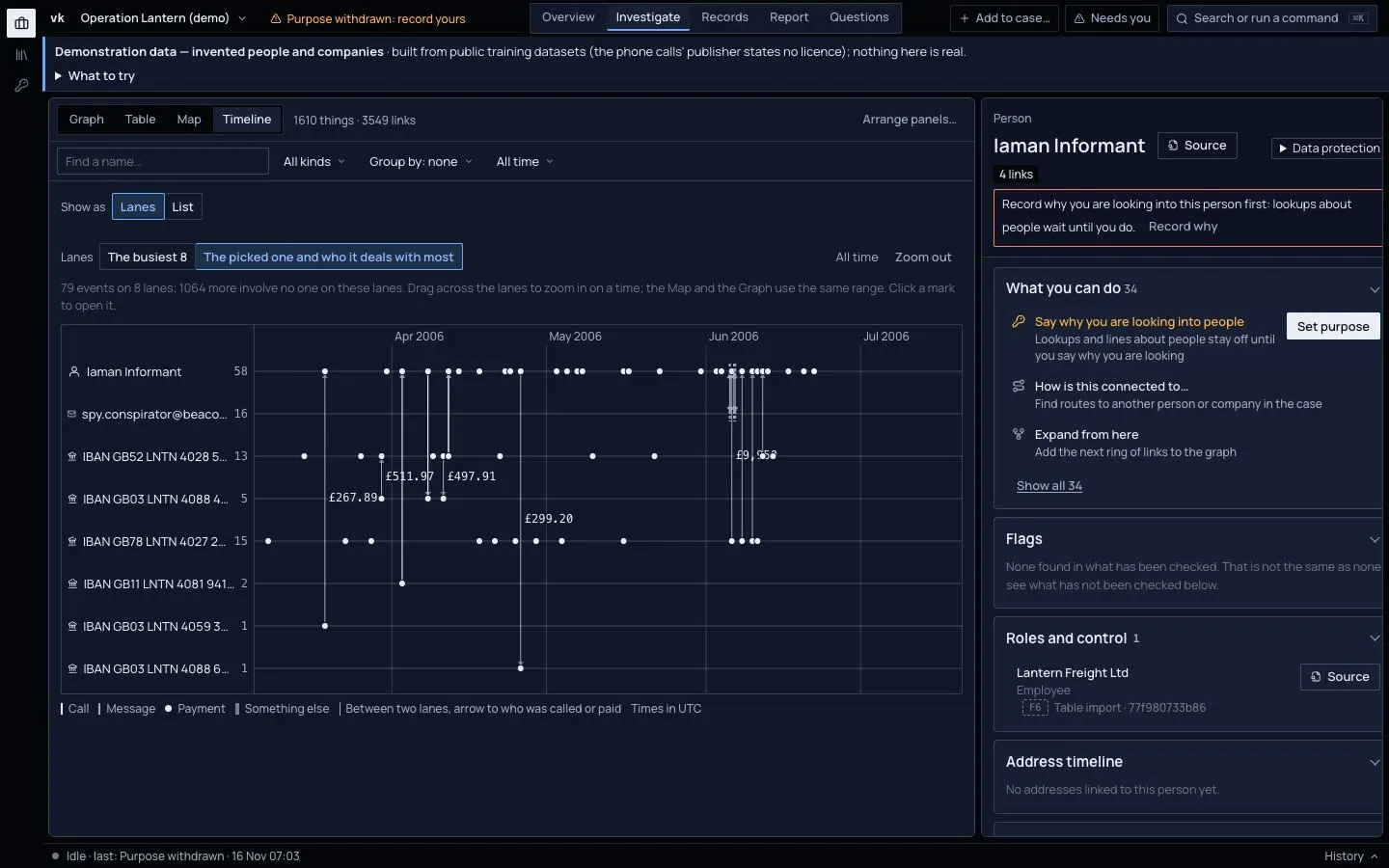
Pick a person or account, then open Investigate › Timeline. With one thing picked, the lanes are that thing and the seven it dealt with most. A person's lane carries the payments of the accounts they hold. Each payment is a dot on both lanes and a tie between them, with the amount beside it and an arrow to whoever was paid. Drag across the lanes to zoom in on a few days; the Map and the Graph follow.
Check what the statement covers
A statement is the bank's view of one account. A counterparty's own account is only as complete as the rows that name it. Two accounts held by one person are two things until you say otherwise. Cash is spotted by words in the row, which banks write differently.