For human-rights investigators
Preserve it as found. Verify it. Keep custody a tribunal can follow.
Footage and posts disappear, and a tribunal will ask where each one came from and who held it. Viokit captures what you find as exhibits with custody, helps you check where and when it was made, and records every conclusion as yours, in the phases the Berkeley Protocol describes.
The questions you start with
- Is this video from where and when it claims to be?
- Where did it first appear, and is it still there?
- Can we preserve it so a tribunal can rely on it?
- Which companies and people supplied, owned or profited?
A worked example
A witness hands over a photo and a video
A witness sends footage and a photo from their phone. Viokit can already:
- Keep each file byte for byte with its fingerprint, who produced it, who handed it over, when and under what authority, and a custody log that only grows.
- Read the photo's metadata: “the file's metadata says it was taken at … on 14 Nov, 16:12, time zone not stated”. It is placed on the map as the file's claim, probable at best, because metadata can be edited.
- Take a still every 10 seconds of the video and transcribe what is said, on your machine. A transcript is a machine reading, to be checked against the recording.
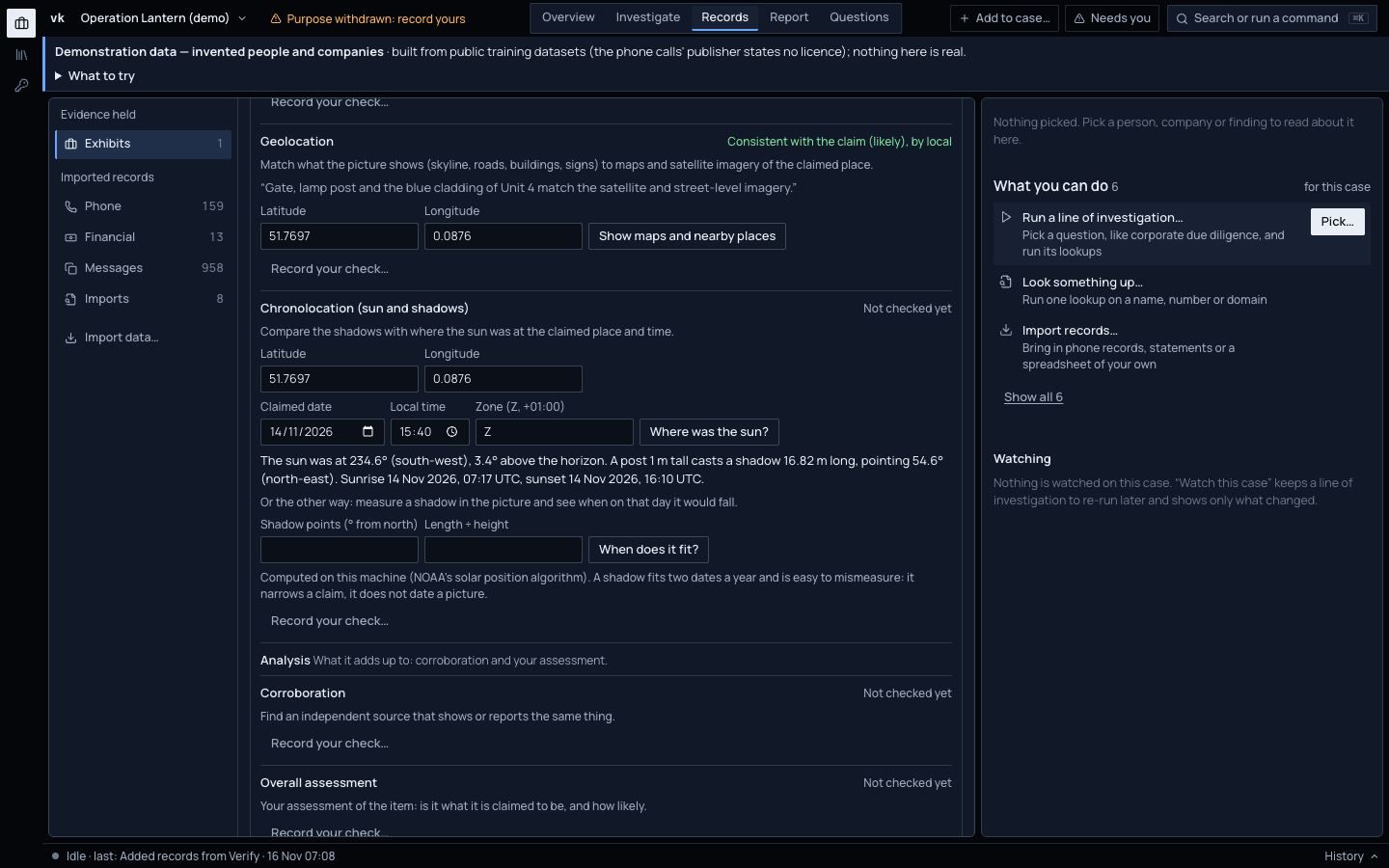
- Give the claimed place and time, and Viokit works out where the sun was: south-west, 3.4° above the horizon, a 1 m post casting a 16.8 m shadow. You compare that with the shadows in the photo.
- Record your view on each check, with how likely you think it is: “consistent with the claim, likely”. Viokit never decides whether the photo is genuine.
- Keep each reading and each check in the case, pointing back to the original, and hand the case over as a bundle a colleague can check.
What matters for your work
Each is built today and links to the guide page that shows it, unless it is marked in progress or planned.
Preserved as found
Every record a lookup returns is kept byte for byte with its fingerprint, when it was fetched and from where. The case history only grows: a correction is a new entry, never an edit.
Evidence in the guide: Evidence you can checkSigned case bundles
One file you can archive or hand over. Any changed, missing or extra part is caught and the file is refused; signed where your organisation has a key.
Evidence in the guide: Case bundlesSafe for sensitive work
Cases stay on your machine, many lookups run offline from data packs, and the AI advisor, if you turn it on, never sees people's names or details.
Evidence in the guide: How Viokit handles your caseWho supplies, owns and profits
Company networks, sanctions screening, aircraft and ship lookups, website infrastructure and web-archive captures.
Evidence in the guide: Lookups and connectionsExhibits and file analysis
Every file or physical item becomes an exhibit with its own custody log. Then metadata, text in images, local transcription of audio and video, and key frames, each result pointing back to its exhibit.
Evidence in the guide: Add an exhibit and analyse itOpen-source media verification
Capture a web page or post as an exhibit: every request and reply, a full-page screenshot and the page as the browser drew it, each fingerprinted, with custody from the start. Save a copy to the Wayback Machine, find the earliest copy an archive holds, work out the sun's position and shadow times, open maps and imagery of a place, and record your checks in the Berkeley Protocol's phases. A site's owner can see a capture, as with any visit.
Evidence in the guide: Verify a photo, video or web page
Against the Berkeley Protocol
The Berkeley Protocol on Digital Open Source Investigations (UN OHCHR and UC Berkeley, 2022) sets out how open-source information should be found, kept and checked. This is where Viokit stands on each phase.
Online inquiry
Built todayLookups across registers, sanctions lists, leaks, websites and the web archive, each recorded in the case history with when and what it found.
Preliminary assessment
Built todayEach source graded for reliability and each fact for how well it is borne out, with the reason.
Collection
Built todayFiles you hold, and physical items, are exhibits with who produced them, who handed them over, the authority and a custody log. A web page or post is captured as an exhibit: every request and reply, a full-page screenshot and the page as the browser drew it, with who captured it, when and how.
Preservation
Built todayWhat Viokit fetches or captures is kept byte for byte, each part fingerprinted, the history only grows, and case bundles can be checked. A copy can be saved to the Wayback Machine, so an archive independent of you holds it too.
Verification
Built todayA checklist for each item: source and uploader, first appearance, metadata, place and time. Viokit runs the look-ups and works out the figures: the earliest archived copy, the sun's position and shadow times, maps, imagery and the nearest named places, and reverse-image search links. Each conclusion is yours, recorded with a likelihood.
Investigative analysis
Built todayLink chart, lane timeline, map over time and findings with a likelihood and their limits. Corroboration and your overall assessment are checks you record. Weighing the evidence and drawing conclusions stays your work.
What is not there yet
We would rather you hear it here than find it on a live case. The direction page says what comes next.
Where Viokit is going- Capturing a page visits it from your computer, so the site's owner can see the visit. When that matters, save it to the Wayback Machine instead, which the Archive's own computers fetch.
- The earliest archived copy says an item existed no later than that date. It is not when the item was made.
- Reverse-image search is a set of links you open yourself; Viokit does not search those services or read their answers.
- Agents that work a question end to end and hand back draft findings are being built, and not ready to use yet.
- Translating transcripts and text is planned.
- A narrative view and a court bundle are planned.
- Viokit follows the Berkeley Protocol's phases, but is not certified against it.